
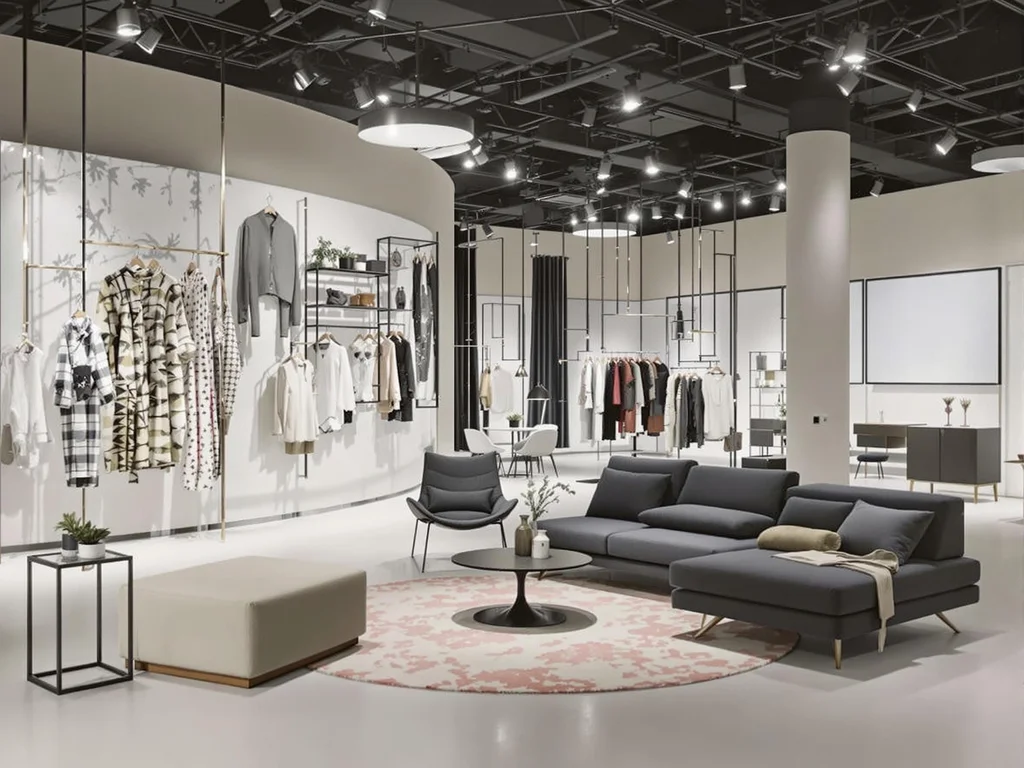
Does your showroom simply display products, or does it actually create a customer experience that leaves a mark?
This article breaks down how to transform your space into an immersive showroom that wins over your visitors and drives your sales.
We reveal the keys to experiential design, today's retail innovations and the strategies for a smooth customer journey, from physical to digital.
You will discover how to redefine your customer relationship and take your brand to the next level by exceeding expectations. A showroom that welcomes regular visitors comes close to sports events setups in terms of flows.
The evolution of the showroom towards customer experience
From point of sale to immersive space
Originally, showrooms worked as simple points of sale. Today, these spaces are reinventing themselves as immersive venues able to awaken visitors' interest through innovative products or new concepts.
Retailers have radically rethought their shops to integrate technologies such as virtual reality. This evolution allows companies to offer enriched customer experiences, with 3D models that can be viewed on site.
Take the example of Samsung 837: this "experiential hub" cleverly combines entertainment and commerce. Modern digital tools, such as interactive kiosks and mobile apps, now optimise the management of in-store interactions.
A real solution for harmonising physical and digital retail, where customers instantly access useful information. Note that online sales have doubled in five years, according to sector figures. These digital tools are also used at corporate seminars, to extend the experience beyond the day.
The pillars of a successful customer experience
The use of customer data combined with AI now personalises journeys live, adapting to the profile of each visitor.
To create a memorable showroom, several key components structure the space:
- Sensory design: A design that stimulates all five senses positively influences how products are perceived and encourages purchase. Retailers have understood this well by working on the lighting and sound ambience of their shops.
- Immersive technology: Augmented reality and virtual displays are redefining how products are tried. These connected solutions merge retail innovation and interactivity.
- Advanced personalisation: Thanks to artificial intelligence, companies adjust their communication according to behaviour observed in store. A real plus for meeting specific expectations.
- Spatial storytelling: Every scenographic element expresses the brand's identity. This theatricalisation of the place turns the customer journey into a tangible story.
- Surprise and wonder: The "wow" effect comes from unexpected installations that leave a mark. A winning strategy for 68% of retailers according to a recent study.
By mastering these levers, the showroom becomes an effective merchandising tool that strengthens customer engagement while boosting sales. These connected solutions fit naturally into our seminar formats, in workshops as well as plenary sessions.
Physical vs digital retail: a strategic complementarity
The link between digital and physical channels is becoming the key to optimising the omnichannel experience.
Click & collect, ordering kiosks, mobile payment... These solutions illustrate the merging of channels. High-performing companies use unified platforms to manage their online shop and their physical store simultaneously. This synergy combines human contact with the power of digital. The result? Products available in real time, optimised stock management and satisfied customers.
Mobile-to-store, in particular, is establishing itself as a formidable strategy for attracting consumers into the shop. Proof of this enthusiasm: 63% of purchases initiated online are now accompanied by a visit to a point of sale.
Source: Observatoire du retail 2023
Design and technology serving emotion
Sensory architecture and the customer journey
Optimising the layout subtly guides customers' emotions, structuring a smooth journey through the shop.
This approach goes beyond simple spatial arrangement: it makes smart use of verticality thanks to event rigging to stage the space.
Materials, lighting and sound ambiences combine to create a memorable experience. Lighting ergonomics directly influences perceptions: carefully designed lighting modulates mood while reflecting the identity of the brand. The soundtrack, for its part, strengthens sensory coherence.
Note that some shops are even experimenting with ambient scents to extend visit time. These systems take individual sensitivities into account, avoiding any counterproductive overstimulation.
A clever kitchen designer could, for example, diffuse the smell of warm bread to anchor their kitchen solution in visitors' minds. This sensory synergy becomes a real lever of non-verbal communication for the company.
Digital tools for tailored interaction
New technologies redefine in-store shopping through advanced personalisation:
- Connected mirrors: Instant visualisation of products with automated suggestions
- Augmented reality: Enriching reality with virtual data
- Interactive kiosks: Independent access to product features
- Projection mapping: Dynamic scenography on the store's walls
- AI: Real-time adaptation of content to the visitor's profile
- Emotion recognition: Adjusting the ambience to facial reactions
- Spatialised sound: Directional acoustic immersion
These solutions transform the management of the customer relationship.
Take the example of a fashion shop: smart mirrors make it possible to try on several outfits virtually, reducing crowding in the fitting rooms. The data collected then feeds operational merchandising.
Behavioural analysis makes it possible to continuously optimise the layout and product rotation. A specialist retailer could, for example, adapt its background music to the footfall measured by its sensors. These systems create a virtuous loop between customer experience and commercial performance.
Ultimately, this fusion of design and technology positions the physical store as a true accelerator of emotions.
Companies that master this alchemy turn every visit into an opportunity for loyalty, while optimising their operational management.
Strengthening the brand image through experience
Spatial storytelling and visual identity
Staging the space makes it possible to embody the values of a brand, creating a tangible link between the design and the company's story.
This approach naturally optimises the customer relationship while strengthening commercial appeal.
Expressing a corporate identity in the physical space requires making its DNA material through architecture, materials or layout.
Take the example of a wellness shop: the use of natural wood, a soothing colour palette and relaxation areas bring its positioning to life.
Every detail then becomes a vector of coherence for the products on display, giving visitors a total immersion in the brand's universe.
Building emotional connection and loyalty
Attachment to a brand is fed by memorable interactions. In-store workshops and exclusive events are also a proven solution for stimulating purchases while consolidating loyalty.
To leave a lasting mark on customers' minds, merchandising professionals rely on several levers. A sensory surprise, such as an innovative virtual staging, often proves more effective than a simple static display.
A car dealer could, for example, turn its showroom into an immersive journey, allowing vehicles to be tested virtually in various settings. Note that interactivity remains a key element: when the customer takes an active part in the in-store experience, their emotional involvement and memory are multiplied.
This type of solution meets consumers' new expectations while strengthening communication around products.
Ultimately, the art of commercial staging allows companies to transcend the simple transaction.
Shops become true brand ambassadors, where every visit is an opportunity to engage with customers.
A strategy that, well executed, positively influences perceived image and sales performance.
Measuring and optimising performance
KPIs and lessons learned
Key metrics provide a tangible assessment of the experiential impact, combining quantitative and qualitative tracking to optimise the customer experience while strengthening the relationship with the customer base.
Building customer feedback into the evolution of retail spaces allows retailers to adjust their offer to market expectations.
To truly measure the effectiveness of a showroom, you need to go beyond analysing turnover. Indicators such as the Net Promoter Score (NPS) reveal the propensity to recommend the brand, while the Customer Satisfaction Score (CSAT) assesses concrete aspects: layout of products, quality of service or clarity of product information.
Take the example of a home decoration shop: its conversion rate (the percentage of visitors making a purchase) directly indicates how effective its space management is.
The average time spent in store becomes a marker of engagement, as does close analysis of customer reviews. Paradoxically, some retailers neglect the Customer Effort Score (CES), which nonetheless measures how easy it is to interact with the physical store.
The solution? Cross-reference this data with qualitative feedback.
One study showed that companies that make effective use of customer feedback have annual growth 10% higher than their competitors. Take the case of a fashion retailer: by repositioning its flagship products according to customer suggestions.
Optimisation also comes through stronger communication between field teams and marketing departments. Merchandising is then refined continuously: lighting, signage, customer journey.
Clearly, this circular approach between data and field redefines the modern management of sales spaces. It remains for shops to find the right balance between standard indicators and metrics specific to their sector.
The future of the experiential showroom
Innovative trends and outlook
Generative AI is now redefining real-time personalisation, permanently changing interactions with customers. But how, concretely?
Generative AI tools now open the way to varied creative content (audio, visuals, simulations) while supporting customer service teams.
Take the example of Showroom privé: their in-house solution generated 20,000 to 25,000 retouched items. Significantly, a virtual showroom for Kenzo saved 1,200 tonnes of CO₂. Retailers adopting these technologies strengthen their position against the competition.
At the same time, experiential design is integrating eco-responsible criteria. This hybridisation of retail innovation and sustainability meets consumers' current requirements while consolidating the company image.
Connected shops are becoming branded communication spaces.
Hybridisation of physical and virtual
Extended reality breaks down geographical boundaries, offering digital immersion on a global scale. Retail VR, for example, uses Matterport digital twins to recreate photorealistic online shops.
These solutions allow companies to test merchandising scenarios before physical rollout. A valuable asset for optimising sales spaces. Customers, for their part, access virtual tours that extend the useful life of physical stands.
Pioneering retailers cleverly combine in-person and virtual store. This strategy creates frictionless shopping journeys where the product adapts to the context of use. The proof: 67% of retailers now see virtual as an indispensable complement.
In conclusion, this hybridisation offers companies a powerful lever for transforming their customer relationship. Today's technological solutions make it possible to optimise ecological impact and consumer engagement at the same time.
The showroom of tomorrow no longer simply displays products. Its challenge? Creating a memorable customer experience by combining digital and physical.
Why not rethink your space as a crucible of emotions and lasting relationships? Because every interaction shapes the future of retail.
At Chroma Technique, we understand that every event is unique. That is why we adapt our solutions to your specific needs. Ready to take the step towards event excellence?
Contact our experts for a personalised quote.
Discover our tailor-made solutions and benefit from our expertise for your next event.