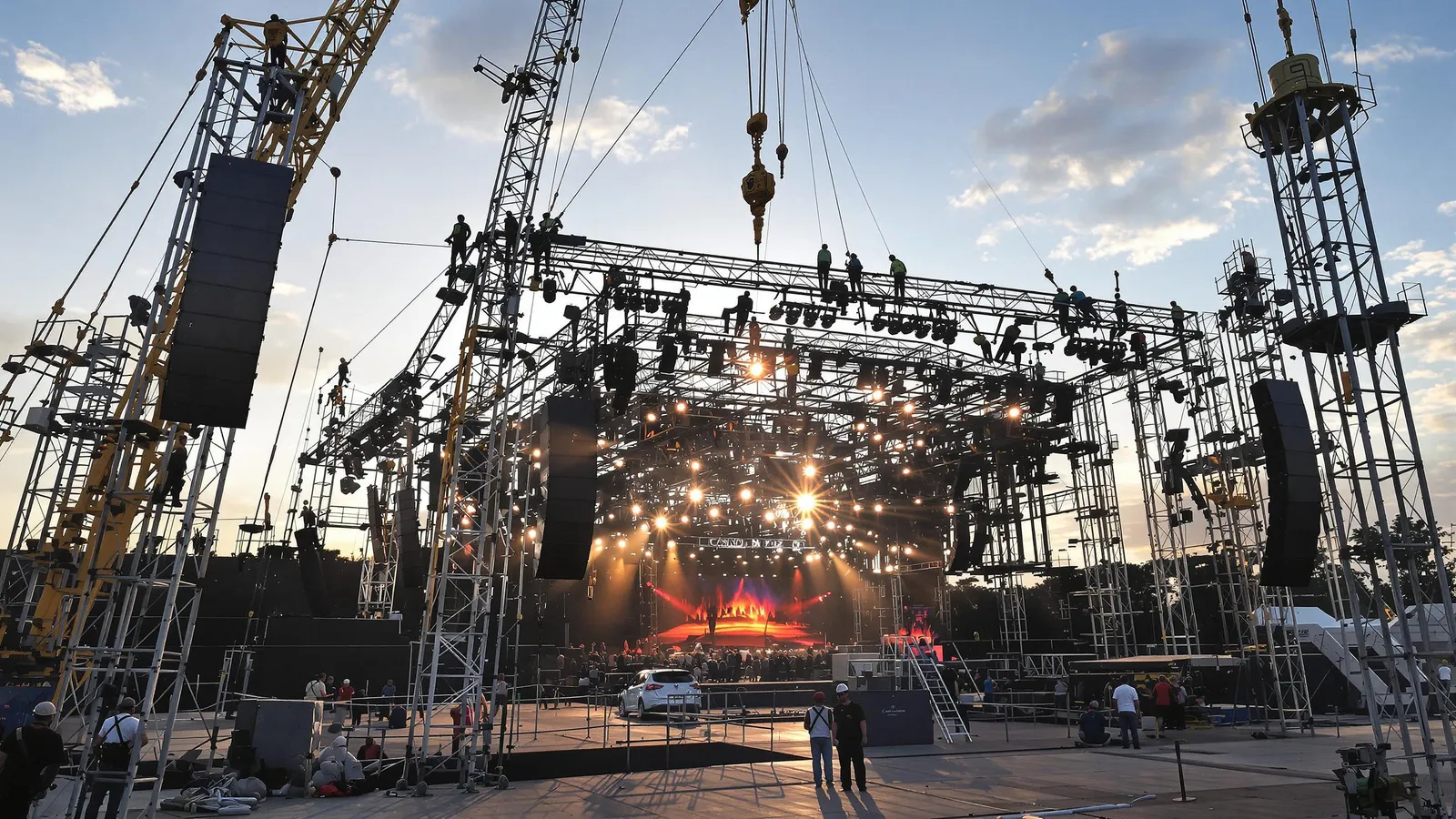
Struggling to secure your event installations without making the logistics heavier?
Event rigging is a bit like the key to combining rigging safety and technical flexibility.
I show you how to choose the right audiovisual equipment, anticipate risks and work with CQP-certified professionals, so your projects take off without the hassle. Our riggers also work on the Côte d'Azur, from our Nice agency.
Safety planning
We always start with the risks. If you are fixing lights or speakers at height, you need to calculate the maximum load before even putting up the first hook.
Suva says it clearly: 95% of mishaps come from poor anticipation. I advise you to work hand in hand with the technical suppliers from the initial plans.
To assess your structures, tools such as SkyCiv do the job. They simulate the stresses on beams and anchors in 2 clicks.
The thing to remember? Always take a 50% margin on your calculations. A truss that supports 500 kg in theory is limited to 250 kg in practice. These safety margins also apply in the Principality, where our Monaco team works in constrained spaces.
Attaching and lifting
The good old German knot remains your best friend for fixing cables. However, if you need to adjust mid-air, favour screw-gate carabiners, which avoids unpleasant surprises.
Rigging professionals often use adjustable slings when the structure is a bit temperamental.
Always check this winning trio before putting anything up:
- Certified slings EN 12195-2: hold up to 2 tonnes
- EN 362 standard carabiners: double-safety locking
- Harness with anti-swing strap: mandatory as soon as you go above 3 m
For narrow spaces or odd angles, we switch to modular equipment. Software such as Braceworks or Production Assist shows you live how to distribute loads without bending the trusses. A calculation note must be presented to the inspection body.
Rigger
The rigger is the one who juggles heights and heavy loads. Their daily work? Hanging lights, checking anchors, anticipating fall risks. The requirement? Having the CQP in your pocket, the certification that is worth its weight in gold in the trade.
The practical modules of the CQP throw you straight in: calculating real loads, handling equipment in real conditions. Career prospects? Festivals, concert halls, or even audiovisual work for the more versatile.
Audiovisual equipment
When you suspend LED lights, the cabling can quickly become a headache.
Synchronising audiovisual equipment with the rigging calls for a double check of the fixings. For a 50 kg line array speaker, we always provide at least two attachment points, even if in theory one would be enough.
- LED lights: 15 kg max with 1 mm² cable
- Line array speakers: 50 kg per attachment point
- Modular LED screens: 200 kg/m² on an offset structure
- Remote-controlled cameras: 8 kg with double securing
- FX fans: 30 kg with anti-rotation anchoring
Something that is often forgotten? Suspended cables. Fit cable clamps every metre and leave some slack for live adjustments. If a connector gives way, it avoids tearing everything out. Allow about 5% of the total weight for cabling.
Types of rigging
Light rigging is your solution for small events, with loads of up to 300 kg. Basic slings are enough.
The different types of rigging become essential when you exceed the weight of a car. At that point, we move to motorised rigging with electric winches and centralised controls.
For improbable places such as disused hangars or historic parks, temporary rigging saves the day. We use modular structures that we adapt on the spot.
The secret? Quick connectors and always a plan B in case the original wall is too rotten to support anything.
Training
The CQP Rigger-Hooker is the key to working on event sites. The official certification is obtained in 35 intensive hours. Prerequisites? An up-to-date SST (workplace first-aid certificate) and a medical certificate for working at height. The practical modules at Arkalya or CFPTS throw you straight in with real simulations.
For electrical authorisations, allow 2 days of specific training. The smart move? Have your PPE validated every year by a professional. Refresher courses take place every 3 years, a chance to catch up on the new standards.
Experience
When an anchor point gives way in the middle of a show, veterans know how to bounce back in 30 seconds flat. Always check the supplier's references: how many festivals they have handled, how they deal with delivery delays.
For live crises, we have our secret checklist:
- Isolate the area within 2 minutes max
- Prepare an alternative scenario for the artists in the air
- Check the PPE before every intervention
Structural analysis software
SkyCiv and Dlubal RFEM are software for simulating stresses. Their free version lets you check the basics, but switch to the pro version as soon as you touch complex structures. Compatible with Mac and PC, these tools calculate in real time how wind or vibrations will affect your installation.
Software can say "OK", but there is also the reality of the field.
Structural analysis
We start by checking every existing anchor point, even those that look solid. At least once a year, an expert goes over everything with a fine-tooth comb. On site, we check visually before each use: corrosion, cracks, loose bolts. Old concrete walls? We do not touch them without additional calculations.
When doubt sets in, we call on specialist engineering consultancies. Their fee? Between €200 and €600 depending on complexity.
They produce reports within 48 hours with the necessary reinforcements.
Safety standards
In France, we have the EN 795 standard for anchor points, with a mandatory check every year. Internationally, riggers often work with ESTA standards, which tolerate heavier loads. If you do not respect the legal framework, it can add up: up to €50,000 in fines in the event of a strict inspection, on top of the risk to the teams.
The latest update? NF EN 17206 of 2020 for stage machinery. To stay within the rules, I check the decrees on Legifrance and the memos from the French Ministry of Culture.
Regulations
Organisers bear criminal liability in the event of an accident.
Mandatory: professional liability insurance covering at least 2 million euros. The Suva guides give legal basics.
For the permit from the town hall, start 3 months before the event. In Paris, allow 8 weeks for processing. The file must include rigging plans, load calculations and equipment certification.
A pro tip? Book an appointment with the city's technical department: they often help to complete the file faster.
Certification
The CQP Rigger-Hooker is your passport to serious sites. This baccalauréat-level qualification (RNCP37847) is validated in 5 intensive days. Allow for a medical certificate and the SST before starting. Employers check this certification first when recruiting for festivals or tours.
Safety planning factors
Before starting the rigging, I always make my personal checklist, and above all always use professionals, you do not joke about safety:
- Check the condition of the load-bearing beams (cracks/rust)
- Check the certificates of the lifting equipment
- Simulate the loads with a 1.5 coefficient
- Validate access for emergency services
Event rigging imposes these rules to avoid tragedies. Rain? We protect the electrical connections.
Fields of application
At corporate events, rigging works wonders. Imagine suspending a giant LED screen above a podium for a keynote, or motorised lights in an industrial loft.
The different types of rigging even adapt to team buildings with interactive structures. The difference from a show? Here, aesthetics matter as much as safety.
The real challenge is ephemeral installations such as pop-up stores. You have to build and de-rig in 2 hours flat without compromising stability. Our tip: modular systems with quick connectors.
Comparison
Choosing between suppliers comes down to three criteria: certifications (CQP mandatory), CE-standard equipment, and responsiveness when something goes wrong. For small budgets, hire solutions exist, but check the insurance clauses.
The best approach? Compare at least three quotes with a risk analysis included. Do not hesitate to ask for client references: a good supplier provides them without batting an eyelid.
For recurring events, negotiate flat rates with an annual review clause.
You are now ready to secure your event rigging installations: plan every attachment, train your teams in good practice and work with certified professionals.
No more taking unnecessary risks: successful events start with reliable structures. See you at the top of the stands for ever more impressive shows... and above all without a hitch!