
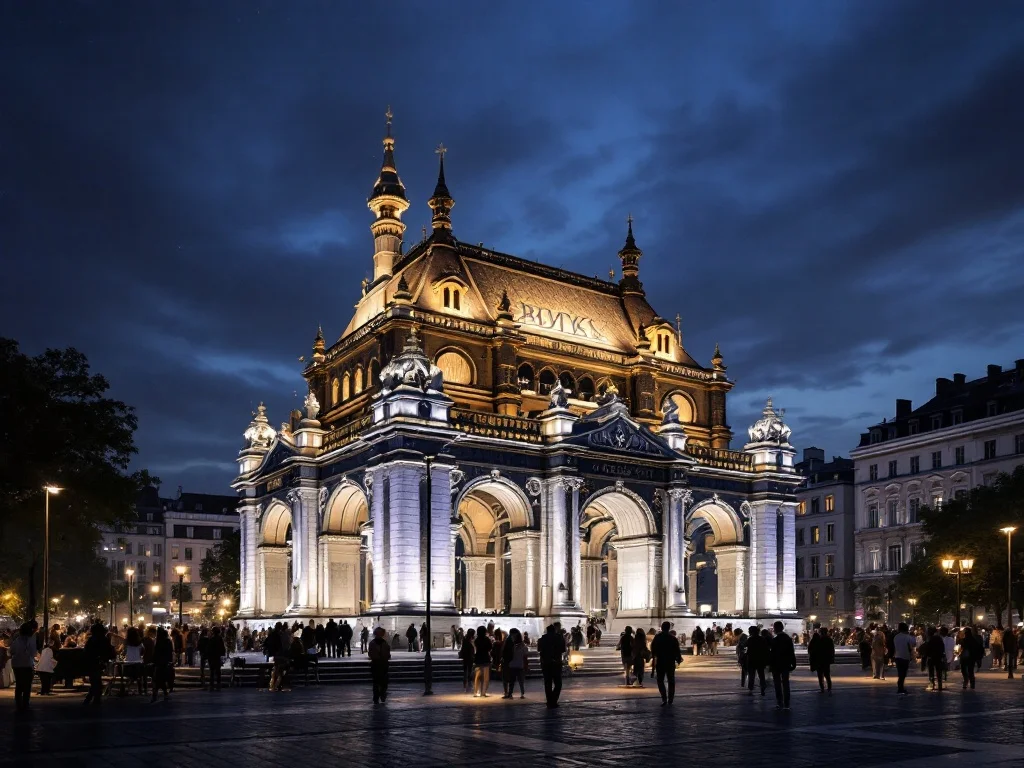
Tired of seeing your building disappear into the night, with no character? Architectural lighting could well change the game.
This practical guide shows you how to make your lighting project a success: from choosing LED projectors to mastering RGBW colours, via the settings for suitable visual comfort.
We also explain how to play with lights for a space enhancement that brings out the building's aesthetic.
Good news: here you will find our product and light fitting comparisons, with real feedback from professionals! These comparisons feed the recommendations of our Île-de-France team on heritage buildings.
Accent lighting
Accent lighting is an essential solution in architecture. This type of LED projector makes it possible to highlight specific elements.
Its purpose? To direct the eye and create striking visual contrasts.
In architecture, which elements get the most out of these RGBW projectors? Let us see how to optimise their use with the latest LEDs.
The arrival of modern LEDs has really changed the game for accent projectors. These compact fixtures now offer precise RGB and white colour management.
Let us talk settings: light intensity and colour temperature can be adjusted to the millimetre. And on the mounting side, there are many options to suit every situation.
A key point? Light quality stays consistent even at full zoom. These products are easily controlled by DMX for professionals, while remaining accessible to the general public. In Alsace, our Strasbourg agency applies these settings to facades that are often listed.
Ambient lighting
Ambient lighting plays a key role in bringing out architectural volumes. For the best result, it is better to mix diffuse light and areas of shadow.
This type of lighting sets the atmosphere of a room.
- Bedrooms: We opt for compact wall-mounted projectors. Their soft light creates a relaxing atmosphere.
- Living rooms: RGBW spots work wonders here. They let you play with colours while highlighting a painting or an architectural feature.
- Connected lighting: DMX projectors come into play. Available in RGB or adjustable white versions, they suit every mood.
- Smart solutions: Some products combine compact LEDs and DMX control. Black or white, these architectural projectors blend in discreetly while offering creative possibilities. Their universal mounting simplifies installation.
- Table lamps: The range now includes compact RGB models. Available in several housing colours (metallic black, matt white), they add a design touch while remaining functional.
In the end, the right mix of LED projectors, controlled colours and architecture-suited products transforms any space.
Wall washing
Wall washing is the technique that lights vertical surfaces evenly. Particularly useful for visually enlarging spaces, let us see how to optimise it.
The choice of projectors then becomes decisive for the final result.
With recessed LED strips, we get discreet solutions. These products allow simple electrical installation, but beware: how do you ensure even distribution without glare?
LED quality plays a key role here. For architecture projects, compact versions with mounting or zoom offer interesting options at a reasonable price.
LED lighting control
Here we present a comparison of lighting control systems for LED projectors. These products meet different needs in interior or exterior architecture.
Good to know: This table compares the prices and technical characteristics of LED products for architecture.
How can these systems be integrated into an existing architecture?
LED projectors
LED projectors prove indispensable for architectural lighting, combining energy efficiency and creativity. Their indoor/outdoor versatility clearly makes the difference. Which zoom angle should you favour depending on the application?
Take the example of compact spots in white or black: their discreet mounting suits every project.
For installation, a track or wall mounting simplifies fitting. On the waterproofing side, the product must absolutely meet outdoor standards - a crucial point for electrical safety.
Good news: existing ranges offer suitable options, with controlled prices even for complex systems. These compact-design products fit in anywhere, from facades to architectural details.
LED strips
LED strips offer a flexible solution for made-to-measure linear lighting. They are often found built into aluminium profiles, especially in interior architecture. But the real choice comes down to LED density?
It all depends on the light intensity you want for your project.
With RGBW and RGB versions, these products allow dynamic colour effects. To control transitions, DMX remains essential - especially in scenography. Note that warm or cool white fits into architectural structures just as well as bright colours.
On the mounting side, plan for a suitable transformer depending on the installed length.
Architectural visual effects
Techniques for playing with the perception of spaces play a key role in lighting projects. LED projectors redraw volumes and shape unique atmospheres. A few options stand out for emphasising relief and reinforcing building aesthetics.
Take the example of a recent museum: their installation combines projectors with a DMX system. The result? A measurable enhancement of the works.
For visual comfort, the choice of white temperatures makes all the difference. Incidentally, some approaches draw directly on event techniques, especially for colour and zoom effects. These architectural solutions make intelligent use of the potential of RGB LEDs, with discreet mounting that preserves clean lines.
At Mvision, for example, they offer a product range suited to electrical and budget constraints. Their catalogue includes projectors, available in fixed or adjustable versions.
A good starting point for projects where the price must stay under control without sacrificing creativity.
3D integration
Predictive simulation software is becoming indispensable for architectural lighting. These tools make it possible to model in 3D and anticipate how LED projectors will look. In practice, parameters are adjusted to obtain realistic architectural lighting.
Working hand in hand between architects and lighting designers is the key. The challenge? Finding the right balance between technique and creativity.
For example, the choice of spots affects the atmosphere as much as the building's aesthetics. Note that good mounting and electrical cabling planned from the 3D plan avoid many problems on site.
On price, the solutions remain attractive for demanding projects.
Standards and safety
For fixed architectural lighting installations, electrical standards are strict. You need to find out about the mandatory certifications - LED projectors for public spaces notably require CE marking.
On the technical side, heat management in compact projectors is paramount. For mounting, favour materials that withstand thermal variations.
Trends and innovations
Luminescent materials and interactive surfaces are among the latest developments in architectural lighting. What stands out in 2024 to transform lighting design?
On the smart-systems side, AI is gradually being built into architectural projectors. These products notably make it possible to automate atmospheres while keeping power consumption under control. How does it work? By dynamically adjusting LED intensity according to the occupancy of the spaces.
For professionals, this technology remains available at an affordable price, especially in compact DMX ranges. Note in passing that optical zoom is becoming widespread on recent spots, simplifying mounting without heavy electrical work.
Comparison
Choosing the right architectural lighting solution depends above all on your budget and the intended use. Above all you need to identify what matters for your type of building. Prices vary quite a lot depending on the products and the ranges available. For an individual who wants to light their interior, LED strips are often enough.
A professional, on the other hand, will prefer higher-performance LED projectors - incidentally, these models exist in black or white depending on the mounting required.
Architects, for their part, often bet on indirect lighting: it costs more at the outset, but it offers more flexibility to play with colours.
Here is how the LED options sit on the market:
Note: This table gives an idea of the prices and lifespan of LED products. The € symbols indicate a relative cost range. Lifespan depends on actual use.
For installation, plan for suitable equipment.
Professional ranges with DMX control generally require more expertise.
Architectural lighting is the art of revealing spaces, improving visual comfort and composing with light. See our LED projectors and light fittings to breathe life into your projects.
Do not delay: tomorrow, building aesthetics will rest on rigorous lighting design and truly mastered space highlighting.