
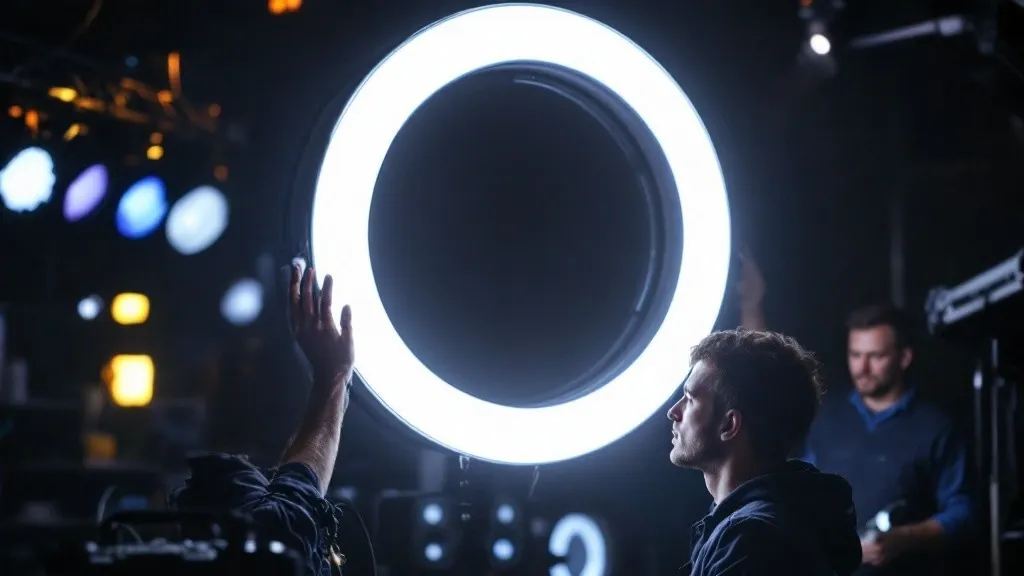
Event lighting has evolved spectacularly in recent years.
Technology keeps advancing, bringing innovative, sustainable solutions for creating memorable experiences at events.
Here is an overview of the key innovations in the field. These innovations are also arriving on the Rhine, where our Strasbourg agency deploys them at urban events.
The benefits of LED technology
LEDs are at the heart of current trends in event lighting. They offer a host of advantages over traditional solutions.
First, they use far less energy. An undeniable asset when you think of large events needing many lighting fixtures.
On top of that, they have a much longer lifespan, which reduces maintenance costs.
Versatility and flexibility
Another quality of LEDs is their versatility. Thanks to their different colours and intensities, it is easy to create varied lighting atmospheres suited to each type of event.
Designers can thus play with lights to highlight certain elements or create a particular atmosphere.
For example, a concert can benefit from dynamic stage lighting thanks to LEDs, while a private party will enjoy a softer, more romantic atmosphere.
- Low energy consumption
- Long lifespan
- Wide range of colours and intensities
- Easy installation and maintenance
Wireless lighting solutions
The trend towards wireless devices is also increasingly marked. These solutions not only save time during installation but also make logistics smoother.
This is a genuine technological innovation that is transforming traditional lighting design. Goodbye bulky cables, hello clean, modular set-ups.
Simplicity and efficiency
Wireless devices are characterised by their ease of use.
They are often controlled via apps on a smartphone or tablet, offering great flexibility. Users can adjust the lighting to their needs in real time.
These technologies also make it possible to synchronise several light sources with each other. This offers fantastic creative possibilities for event organisers wanting to impress their audience.
Sustainable lighting to meet ecological challenges
In a world where sustainability has become paramount, sustainable lighting solutions are taking up more and more space in event organisers' choices.
By adopting energy-efficient technologies such as LEDs and reducing power consumption through smart energy management systems, it is possible to minimise the carbon footprint of events without compromising the quality of the lighting atmosphere.
Smart lighting technologies
Smart lighting systems play a crucial role in this transition to greener practices.
For example, integrating motion sensors makes it possible to switch on the lighting only when it is needed.
In addition, some platforms make it possible to track and analyse energy consumption in real time and automatically adjust the settings to optimise efficiency.
Creating memorable experiences through lighting
The main aim of any event is to leave a mark. Lighting plays a leading role here, able to completely transform the atmosphere and stir powerful emotions in participants.
Much more than a simple accessory, it is a central element of scenography that directly influences how the audience perceives the event.
Staging and storytelling
Lighting designers often use light as a narrative tool. Well-thought-out lighting can tell a story, guide spectators or underline the key moments of a performance.
For example, the judicious use of contrasts and colours can help build dramatic tension during a theatre show or heighten euphoria at a music festival.
Immersive atmospheres
With recent advances, it is now possible to create entirely immersive environments using light.
Video projections and high-resolution LED screens contribute to this immersion by literally transforming the space.
This approach is ideal for product launches, themed parties or even art exhibitions, where the aim is to immerse participants completely in a unique visual world.
Future trends and outlook
Finally, let us take a look at the emerging trends that could revolutionise event lighting again in the coming years.
We are seeing a convergence of lighting technologies with other fields such as augmented and virtual reality.
Imagine interactive shows where light reacts directly to participants' movements, or concerts where the scenography is enriched with virtual elements integrated live.
Integration with AI and IoT
Lighting technologies are also increasingly incorporating artificial intelligence (AI) and the internet of things (IoT).
These innovations make it possible to automate and continuously optimise lighting according to a multitude of parameters such as the position of spectators, the time of day or even individual preferences detected in real time.
These advances open up immense prospects for making events ever more personalised, engaging and dynamic.
Ever higher-performing eco-friendly lighting
In parallel, continuing research into materials and manufacturing techniques is leading to LED lighting that is even higher-performing and kinder to the environment.
Miniaturisation and improved light output now make it possible to offer compact, powerful and ultra energy-efficient fixtures.
Organisers can thus combine creativity, technical performance and respect for the environment to meet the public's growing expectations on sustainability. This demand for sustainability runs through all our audiovisual solutions, from the equipment fleet to transport.