
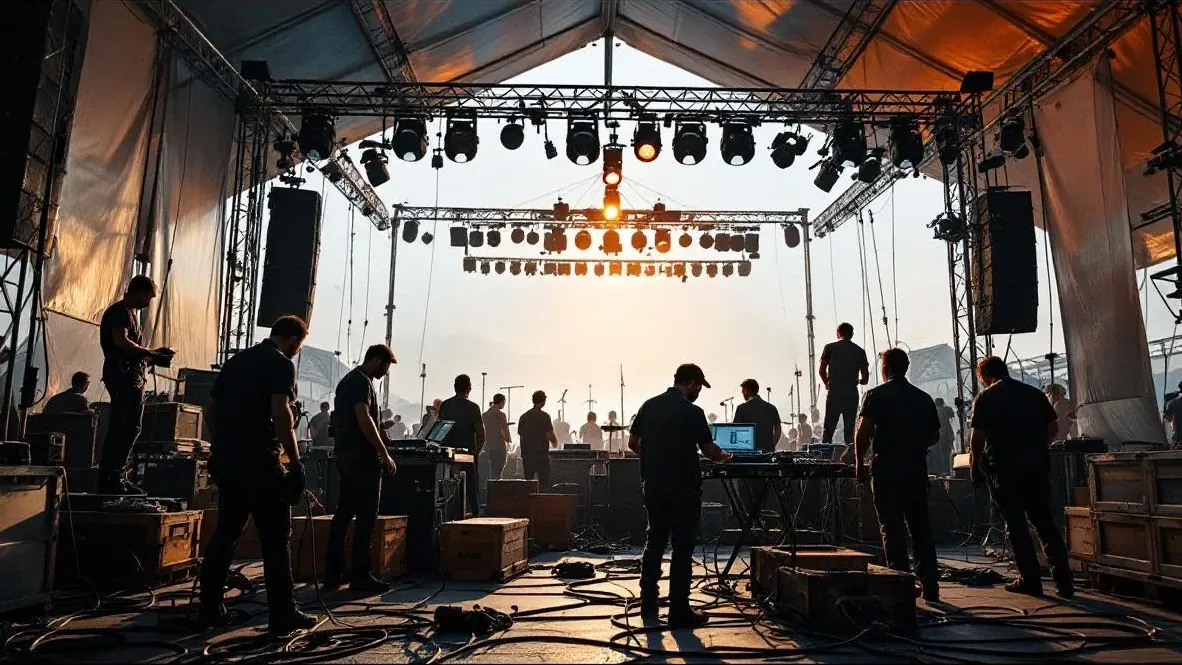
Organising a festival is like orchestrating a complex symphony in which every element must be in perfect harmony. Yet behind the glittering curtain of cultural events lies a well-oiled machine, technical production, which ensures the show runs smoothly. Let us explore some of the most crucial aspects of this titanic task. On the Côte d'Azur, these festivals are put together by our Nice team, who know the sites and the permits.
What is technical production at a festival?
At the base of every major cultural event is a technical production team. This group of professionals is responsible for making sure that all the technical aspects of a festival run without a hitch. This includes not only lighting and sound, but also video management, special effects and any other technological requirement needed to deliver an unforgettable experience to spectators.
The main objective of technical production is to synchronise these various elements perfectly. They often have to work under pressure, particularly when time is short or last-minute changes are needed, demonstrating their mastery of handling the unexpected. Their ability to react quickly and effectively is essential to the success of a festival. This synchronisation also applies to filming, which must follow the programme without ever delaying it.
The main components of technical production
- Lighting: essential for creating the desired atmosphere and showcasing performances.
- Sound: guaranteeing impeccable acoustics so that every note, word or effect is heard clearly by the audience.
- Video: visual projections, giant screens and so on, for total immersion.
- Special effects: smoke, lasers and pyrotechnics to enhance the show.
These components are the foundations on which all the technical work of a festival rests. Their skilful combination turns the event into a true sensory celebration. To learn more about the experiences shared on this subject, see our blog.
What are the logistical challenges of technical production?
One of the first major challenges facing technical production is planning. Before the artists even step on stage, every logistical detail must be meticulously organised. From technical coordination between the different suppliers to transporting equipment, every step requires particular attention.
Then there is safety, for both the teams and the public. Every technical installation must meet strict standards to avoid accidents. Technicians must also be trained to handle emergency situations, proof that good production knows how to anticipate as well as react.
Transporting and installing equipment
The transport of equipment is a major test in itself. Each piece must be carefully packed, shipped and installed with precision. This step demands exceptional coordination between the different departments involved in event logistics. Errors can lead to costly delays or compromise the quality of the show.
In addition, installation often has to be done in record time. Technicians constantly build up their know-how to improve the efficiency of installations while meeting sometimes very tight deadlines. This agility is one of the key characteristics of any successful event.
How does technical production manage artists during a festival?
Artist management is a delicate aspect of festival programming. Ensuring a flawless schedule and coordinating the specific needs of each artist is a real organisational challenge. Each artist must receive technical support suited to their performance and respect the agreed timing constraints.
This implies smooth communication between all the teams involved. Whether adjusting specific sound equipment or preparing special lighting, every detail must be perfected. Rigour in this coordination guarantees the artist's comfort while ensuring a high-quality performance for the public.
Accommodation and associated services
For the duration of the festival, it is also essential to take care of the accommodation of artists and their teams. Finding suitable lodging and coordinating transport to and from the site requires great organisation in terms of event logistics. It is a logistical puzzle that must be put together with care.
Besides accommodation, various other services, such as catering or VIP hospitality, must be planned to meet the artists' varied needs. Offering a personalised service can make a notable difference to their overall experience.
Technology tools to optimise technical production
With the rapid evolution of technologies, technical production now has many tools to simplify and optimise its operations. Some software, for example, allows better planning and real-time tracking of the progress of each task. The use of integrated platforms also eases technical coordination between the different units.
Other innovations support production, such as automated lighting and sound systems, which considerably reduce the margin for human error. This lightens the teams' mental load while delivering a result of very high precision. Thanks to this progress, the level of requirement can be raised considerably.
Safety and advanced technologies
A few specialist applications now make it possible to anticipate and manage potential crises during the festival, notably in the event of bad weather or technical mishaps. Using advanced detection and rapid response systems helps raise the overall safety of the event while protecting participants.
Setting up these tools does require a significant initial investment. However, the long-term benefits in safety and smooth running largely justify the effort. Using these technologies can indeed turn logistical challenges into opportunities for development and innovation.
Event logistics and the future of technical production
With the global pandemic having redefined working methods, event logistics has undergone a radical transformation. Technical production has had to adapt to new social distancing rules and a changing environment. All this reinforces the need for greater flexibility and ever finer anticipation in preparing every technical aspect.
Some festivals have chosen to turn to hybrid formats, combining on-site performances and digital broadcasts. Although this introduces new challenges, it also widens the field of possibilities. Technical skills become more versatile, also covering streaming and digital audiovisual production.
Prospects for the future
Looking ahead, technical production continues to evolve with the gradual adoption of green and sustainable technologies. Initiatives to reduce the ecological footprint of festivals are gaining ground, directly influencing logistics practices. This transition aims to satisfy both the growing collective awareness of environmental issues and the operational requirements of large events.
Ultimately, technical production remains the invisible pillar around which all efforts revolve. As innovations continue to transform the entertainment industry, only proactive anticipation and flawless execution will allow the future chapters of global cultural history to be written.