
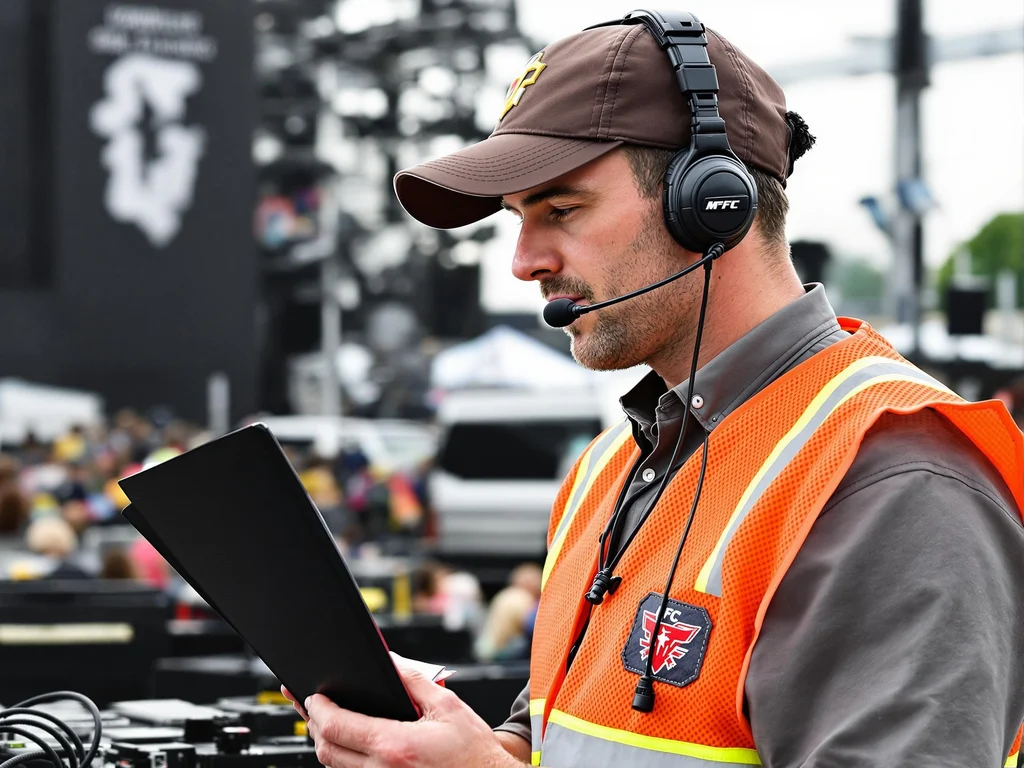
Do you love the world of live performance and wonder how the magic of an event is created? Equipment management, team coordination…
We explain the central role of the event technical director.
This article explores the behind-the-scenes of the profession: skills required, available training and career opportunities. You will also find insight into Chroma Technique's expertise in event audiovisual in Paris.
Want to master the workings of show technology? Let's find out what really goes on behind the curtain.
Role and duties of the event technical director
To go deeper into the duties and skills of the event technical director, our article covers the essentials.
Coordinating technical resources
At the heart of event production, this professional manages the deployment of equipment and people.
Their role? Organising the use of audiovisual equipment while directing the different trades. A mission that requires detailed knowledge of the specifics of each venue and of audience expectations.
Anticipating needs is the key.
Whether for indoor or outdoor shows, fine-tuning technical solutions demands constant adaptability. It is about finding the right balance between budget constraints, artistic requirements and operational reality.
A constant process of adjustment in which every decision directly affects the final quality as perceived by the audience.
Managing teams and suppliers
An event's success often rests on the know-how of its technical professionals. Here is what makes the difference day to day:
- Operational management: Harmonising the work of sound, lighting and video specialists takes split-second coordination. The challenge? Avoiding mix-ups during performances.
- Smooth communication: Passing on instructions clearly saves precious time during rehearsals. A good point? Knowing how to rephrase artistic requests in concrete terms for the teams.
- Problem solving: When a technical issue arises, it is often down to the stage manager to find quick fixes. The goal? Stay on course despite the unexpected.
- Supporting talent: Motivating a team means recognising everyone's skills. A tip? Delegate wisely according to individual expertise.
These practices ensure the best use of technical skills throughout the creative process.
Collaboration between stage management and artistic departments is sometimes a balancing act. On one side the creative requirements, on the other material realities.
The professional must constantly juggle these two dimensions to arrive at a staging that is both ambitious and achievable. A process of adjustment that runs from the first site visit to the final de-rig.
Safety and regulatory standards
In live performance, compliance with standards is not negotiable. Responsible for operating the equipment, the technician systematically checks the compliance of installations.
Particular vigilance is needed in heritage sites, where every technical intervention must preserve the integrity of the venue.
Risk analysis is an integral part of preparation. Before each performance, a thorough check of safety systems is essential.
This applies equally to lifting equipment and emergency systems.
An approach that protects the audience, the performers and the professionals working on the event alike.
Training and career path
Career progression in events
With a few years of running projects behind them, moves into production become possible.
Some professionals move towards stage management or the coordination of cultural venues. These changes generally require regular upgrading of skills, especially on new equipment.
Note that audiovisual remains a growth area. Keeping up to date with the latest creative tools is becoming almost essential for professionals who want to stay competitive. Ongoing training is therefore a natural requirement in this field.
As we know, nothing replaces hands-on experience in this sector. Good practice allows you to develop real artistic and professional know-how.
This is often what makes the difference when managing technical resources and teams on complex productions.
Salary and benefits
In the Paris region, pay varies widely depending on the organisation and how artistic skills are used. For experienced professionals, the material resources allocated also influence the overall package.
Good knowledge of the venues and available equipment can make the difference in negotiations.
Chroma Technique's technical expertise
With its experience, Chroma Technique, an event agency in Paris, brings its know-how to a variety of projects for industry professionals.
Innovative audiovisual solutions
Using the latest technologies in artistic creation guides Chroma Technique's approach. The agency delivers tailor-made audiovisual solutions to turn concepts into striking productions.
This strength makes it possible to design unique shows thanks to suitable technical resources and genuine stage management expertise.
Chroma Technique stands out for a high-end equipment fleet, decisive for the success of your projects.
- High-resolution LED screens: For optimal image quality, our screens adapt to every venue configuration, from conference rooms to large spaces.
- Immersive sound systems: Sound that ensures precise coverage, ideal for holding the audience's attention.
- Intelligent stage lighting: Fixtures and consoles that create artistic atmospheres to enhance every key moment.
- 4K video recording solutions: To capture your productions with polished image-making, thanks to high-performing cameras and distribution systems.
- Augmented reality tools: An innovative approach that immerses the audience in interactive worlds, strengthening the impact of artistic creations.
This diversity of equipment meets the specific needs of professionals, guaranteeing visual and sound quality suited to every production.
Managing complex projects
Delivering ambitious shows relies on a proven methodology. Chroma Technique applies a rigorous quality process built around several areas: detailed planning, coordination of technical teams, and constant tracking of key indicators. An approach that combines professional rigour with artistic adaptability.
The organisation of the Microsoft AI Tour is a concrete illustration of this expertise. This large-scale project required optimal use of technical resources and close coordination between the different teams, managed by the agency Nteractive.
The result? A smooth production that impressed participants with its artistic and technical coherence. Proof by example that bringing professional skills together effectively makes the difference.
Future challenges for the profession
Ecological transition in events
Integrating environmental standards into technical choices is a key issue for the future. Stage management professionals must now assess the ecological impact of their decisions and favour sustainable solutions.
This approach requires regular updating of skills, especially to make full use of new eco-friendly equipment. Note that this shift directly affects artistic creation and the production of shows.
Working with committed suppliers is becoming common. The idea? Set up partnerships that genuinely take environmental constraints into account. This collaboration facilitates the reasoned use of technical resources while reducing the ecological footprint.
For example, using recyclable equipment or pooling resources between professionals are among the emerging practices. A concrete way of acting across the whole chain of artistic production.
Digitalisation of events
The digitalisation of events is profoundly changing the work of stage management, notably through the addition of hybrid technologies.
Digital tools are transforming professionals' daily work. Mastering online broadcast platforms and new software is now one of the key duties. This shift directly affects team coordination and calls for constant adaptation.
Let us look here at how professional training plays a central role in maintaining the quality of shows.
Multichannel broadcasts pose interesting challenges. You need to anticipate technical skill requirements while managing the simultaneous operation of several channels.
Implementation calls for good knowledge of the equipment and flawless organisation. This is where the role of stage management becomes decisive in ensuring consistency between artistic creation and its delivery to the audience.
Between team coordination and mastery of innovative audiovisual tools, the event technical director plays a central role.
Need an event without a hitch? Chroma Technique puts its expertise at your service.
Why not get in touch now? Together, let's bring your projects to life! The technical director also decides on the move to a hybrid format when part of the audience follows remotely.