
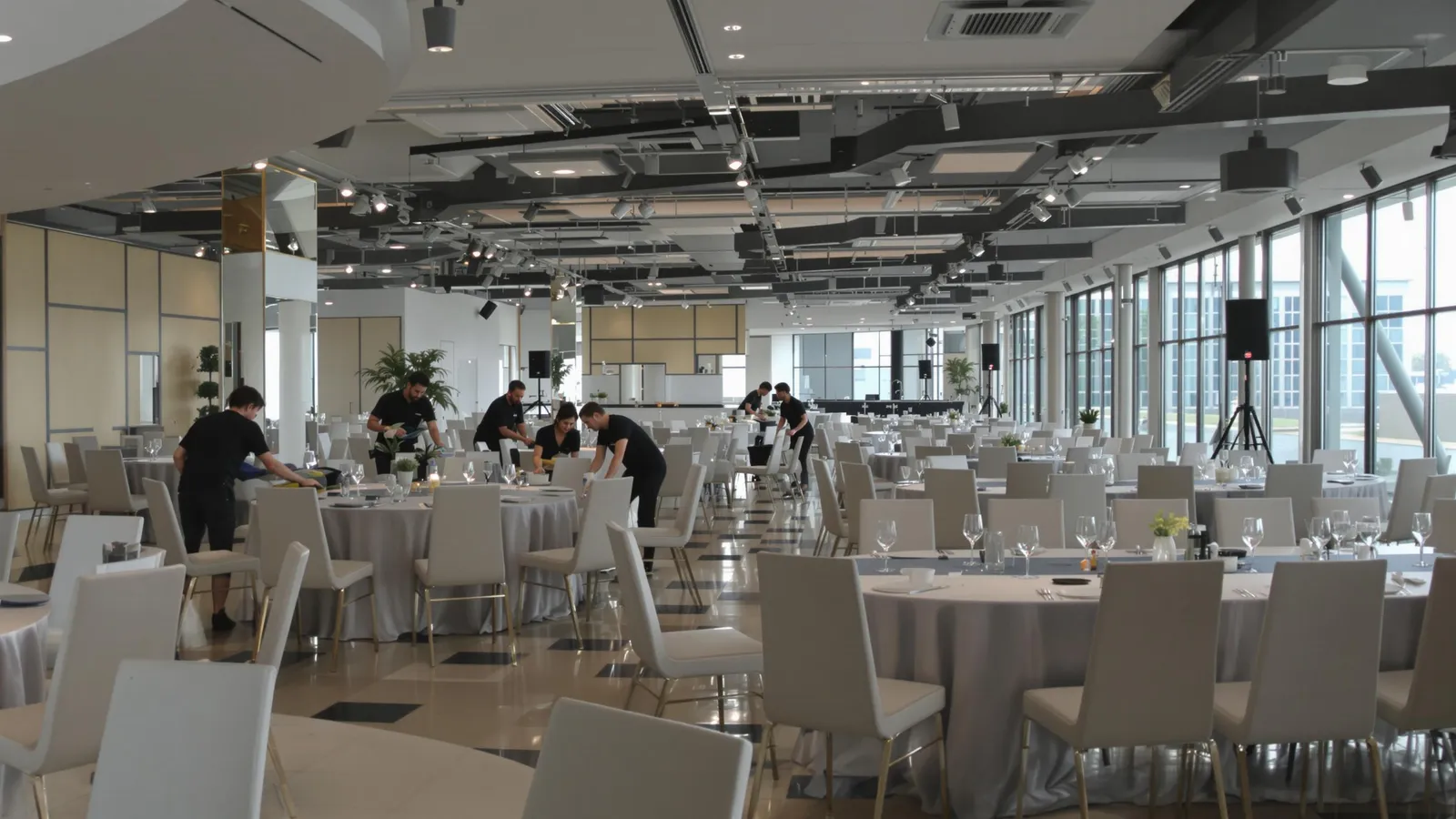
Organising events can look simple from the outside, but a whole world of preparation and coordination works behind the scenes to guarantee success.
Since the backstage of a corporate event hides meticulous planning work, our agency invites you to discover the secrets that make the difference between a successful party and a failure.
You will see how event professionals orchestrate every stage, from the first meetings to welcoming guests on show day.
Behind the scenes of event organisation
The invisible preparation of large events
Behind every successful event lies a mountain of preparatory work that nobody sees.
Preparing a corporate event usually starts several months in advance. We define the objectives and the target audience before looking for the perfect venue. Then we contact the various suppliers for catering, technical services and entertainment. The budget is tracked closely to avoid overruns.
This meticulous preparation makes all the difference between an ordinary event and a memorable experience for guests.
The key players behind the scenes
A successful professional event relies on a team with varied skills working behind the scenes.
The event project manager coordinates everything and acts as the link with the client. The technical teams take care of sound, lighting and scenography, which turn an empty space into a place of experience.
External suppliers bring their specific know-how, from the caterer who delights the guests to the DJ who livens up the party.
The expertise of an event agency in Paris is a major asset for the success of your projects.
A successful event requires a variety of skills.
- Production manager: Makes sure the equipment works properly.
- Logistics coordinator: Manages the flow of people and equipment.
- Safety officer: Guarantees a safe environment for everyone.
- Graphic designer: Creates the visual materials for the event.
A tight-knit team is the key to a successful event.
Strategic event planning
Good planning is the foundation on which the organisation of any event rests.
Planning a corporate event is a bit like putting together a puzzle. We start by defining the date and the objectives of the event. Then we create a reverse schedule that details all the actions to be carried out and their deadlines. Budget management runs in parallel because it influences every decision.
To deepen your knowledge of the different organisation stages, read our article on how to organise a successful corporate event.
Each type of event requires a specific approach to planning.
Logistical challenges and their solutions
Organising a corporate event always raises logistical challenges. Between venue constraints, tight deadlines and clients' special requests, creativity is needed.
Delivery delays and last-minute cancellations are classics that teams must adapt to quickly.
Faced with these challenges, organisers develop tailored solutions. We always prepare a plan B for key elements such as the venue or the main speakers. Project management tools make it possible to follow the progress of preparations in real time.
We also build solid relationships with several suppliers so that we have alternatives if one of them lets us down.
The experience accumulated over event projects makes it possible to anticipate problems before they arise.
Managing resources and teams
Building and managing the event team
To make a corporate event a success, start by putting together a team with the right skills.
The team is usually built around the specific needs of the event project. A seminar and a corporate party call for different profiles.
My advice is to first identify the key skills required for each stage, then find the people who match.
The size of the team must fit the scale of the event: too small and you will be overwhelmed, too big and coordination becomes complicated.
The success of an event depends greatly on the motivation of teams who often work under pressure.
Managing the budget and suppliers
Budget management is a critical point for any event project, especially when organising corporate events or team building.
To manage an event budget well, first assess all the expense items precisely (venue hire, catering, entertainment, technical services). Suppliers should be selected after comparing several quotes, taking into account their experience and references.
I recommend allowing a 10-15% margin for the unforeseen, which always happens. Putting budget tracking tools in place gives a clear view of expenses in real time and avoids unpleasant surprises.
Technology tools serving events
New technologies have really changed the way we organise events and manage teams.
We now use plenty of tools that make planning and event organisation easier. Project management software such as Asana or Trello is very handy for tracking tasks and planning. Online registration platforms greatly simplify participant management.
Event apps let guests access the programme and practical information directly on their phones.
Setting up and running the event
Show day: coordination and handling the unexpected
An organiser's day starts early, to check that everything is ready before the guests arrive. We do a quick tour of the venue to make sure the installation matches the original plan. The teams are briefed one last time and everyone knows what they have to do.
You have to be everywhere at once, answering suppliers' questions and handling small last-minute adjustments.
When the unexpected happens, you have to stay calm and find solutions quickly. A speaker drops out? We always have a plan B. A technical problem with the sound?
The technical team is there for that. Delays in the delivery of furniture? We reorganise the space with what we already have. The main thing is never to let participants see the stress and to offer them a smooth experience.
Welcoming guests and the participant experience
Welcoming participants is a key moment that sets the tone for the whole event. We make sure the signage is clear so that guests can easily find their way.
The reception team is trained to answer questions with a smile. For large corporate parties, we provide several check-in points to avoid queues.
The first moments are truly decisive in putting participants in the right frame of mind.
To create a memorable experience, we focus on small personalised touches. Name badges prepared in advance, a welcome gift linked to the theme of the event, or surprise entertainment that creates emotional moments.
We also make sure that participants' specific needs are taken into account, such as special diets or accessibility for all. The aim is for everyone to feel treated as a special guest, not just a number.
Communication during the event
Effective communication between teams is essential for everything to go well during the event.
- Walkie-talkies: They allow direct, instant communication.
- Instant messaging: Quick, efficient written exchanges.
- Project management platforms: For task tracking and coordination.
- Video conferencing: For remote meetings if necessary.
These tools ensure smooth, responsive communication.
We adapt the way we communicate to the different phases of the event. During the set-up, we concentrate on coordinating the technical teams and checking the equipment. At the welcome stage, the whole team is informed of the detailed programme and of any VIPs to be received.
During the event, we share information about timing changes if necessary. At closing, we do a quick review of the de-rig and packing away. What matters is that information flows quickly and well between all those involved.
Creative and technical aspects
When organising an event, you have to juggle creativity and technical constraints. It is a bit like a balancing act.
We often have great ideas, but we have to see whether they can be delivered within our budget. Innovation has become essential in the events sector, as guests expect to live unique experiences.
Our clients ask us to surprise their employees, so we constantly have to renew concepts.
Scenography plays a major role in creating the atmosphere of a professional event. We start by defining the visual concept according to the message the company wants to convey. The venue strongly influences our creative choices: you do not prepare a corporate party in a château the same way as in an industrial loft.
Technical constraints sometimes force us to rethink our ideas, for example when power is limited or the ceiling height is insufficient.
New technologies such as projection mapping and augmented reality open up incredible possibilities for transforming a space.
After the event: analysis and feedback
Assessing the success of the event
We measure the success of an event with precise indicators such as the number of participants, the impact on social media and the return on investment.
Satisfaction questionnaires are very useful for gathering participants' views. We usually send them within 48 hours of the event so that impressions are still fresh. Dedicated event apps also make it easier to collect this feedback in real time.
For qualitative data, we group comments by theme to better identify strengths and areas for improvement.
We often complete this analysis by monitoring social media mentions, which gives a good idea of the impact of our organisation.
Debriefing and continuous improvement
The post-event debrief is an important moment when the whole team gets together to take stock. We usually start by reviewing the objectives set at the outset to see whether they were achieved.
We then analyse what worked well and what caused problems during the event. We also invite key team members to share their feelings and their observations from the field.
To turn mistakes into learning opportunities, we document them without looking for culprits. We create procedure guides that capture the good practices identified during the project. To build all this into our future events, we update our internal checklists and processes.
We also train teams on new tools or methods that have proved their worth.
Post-event communication
After the event, we stay in touch with participants and partners to extend the impact of our organisation.
Photos and videos of the event are great material for showcasing what happened. We select the best moments to create an album or a highlights video that we share on our website and social networks.
To maximise the impact, we tag participants in the photos where possible, which encourages them to share the content with their own network.
We also use these visuals in our thank-you newsletters and to illustrate our future communication materials when seeking new clients or partners.
Trends and developments in the events sector
Technological innovations transforming events
The events sector is evolving very fast, with new technologies changing the way professional events are organised. The evolution of the sector is also marked by the rise of hybrid events, combining in-person and digital.
Hybrid formats are a practical answer to companies' current needs. We can now offer a seminar where some employees are present on site while others follow remotely. The success of this type of event depends greatly on technical quality and the tools used.
The main concern remains keeping the attention of remote participants, who can easily get distracted.
For this, I recommend alternating presentations with short interactive sessions.
Teams now train continuously to keep up with these technical changes. This kind of constraint can often be lifted by running part of the programme in a hybrid format.
Eco-responsible events
Clients increasingly ask us for greener events. It is a genuine trend that is taking hold in event organisation.
To meet these expectations, we have put in place several simple but effective solutions. First, we favour hiring equipment rather than buying it, to reduce waste.
Next, we choose venues that are easy to reach by public transport, to limit the carbon impact of travel.
We also work with caterers who source locally and seasonally. Finally, we set up effective sorting for waste during the event.
Personalisation and the client experience
Personalisation is becoming an important element of event organisation. Guests no longer want standardised experiences.
To create standout moments, we use several techniques that are fairly easy to set up. Mobile apps allow us to collect participants' preferences even before show day.
We can also create differentiated journeys depending on guest profiles. Personalisation also comes through small touches such as name badges with relevant information to make networking easier.
Interactive activities let participants contribute actively rather than being spectators.
Organising professional events takes far more work behind the scenes than people imagine. Thanks to meticulous planning, a tight-knit team and suitable tools, you will turn your logistical challenges into memorable successes.
The real talent of an organiser lies precisely there: making simple what in reality requires intense, meticulous preparation.