
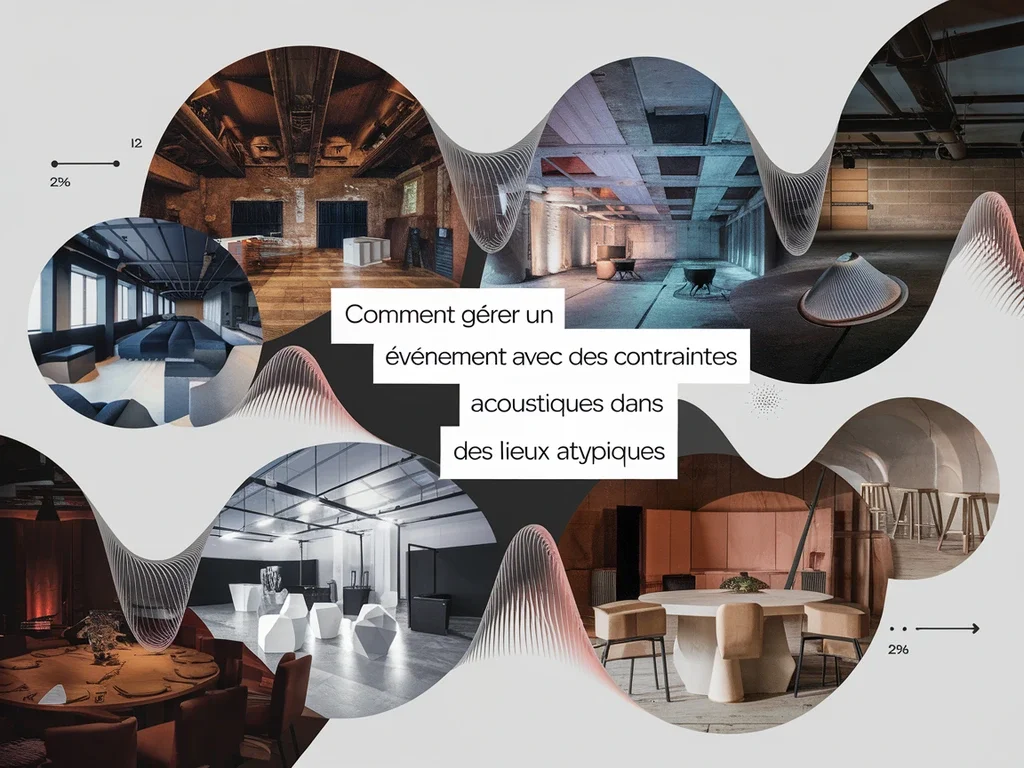
How to optimise the acoustics of an unusual venue for a successful event
According to a 2023 IFOP study, 64% of event organisers choose unusual venues to stand out. These spaces, although original and inspiring, often pose complex acoustic challenges.
Rigorous management and suitable solutions make it possible to turn these constraints into opportunities and deliver an optimal sound experience. Here are the key steps to get there. For unusual venues in Paris, it is our Paris team that carries out the acoustic survey before booking.
Understanding the acoustic challenges of unusual venues
Unusual venues generally present three main challenges:
- Excessive reverberation: industrial or large spaces often have a high reverberation time, reaching 3.5 seconds, whereas the recommended standard is 1.2 seconds for good intelligibility.
- Reflective surfaces: materials such as concrete, glass or metal amplify echoes and make sound clarity harder.
- Architectural interference: structural obstacles, such as columns or closed corners, cause an average loss of 12 dB in some areas.
These factors call for a specific technical approach to optimise sound distribution and balance. These surveys feed directly into event project management, which weighs up venue, budget and set-up.
Analysing and assessing the venue’s acoustics
A prior acoustic analysis is essential to identify the specific constraints of the space. This includes a site visit to assess the dimensions, materials and architectural features.
For example, an open space amplifies echoes, while a partitioned venue limits sound propagation.
Today, specialist software makes this step easier. Soundvision (L-Acoustics) and ArrayCalc (d&b audiotechnik) make it possible to simulate sound configurations accurately:
- Measuring the reverberation time to adjust the equipment.
- Creating an acoustic heat map to visualise reflection and absorption zones.
- Simulating sound system setups to optimise sound coverage and anticipate potential problems.
These tools make it possible to identify up to 89% of problems before installation and to cut the final technical budget by 40% by avoiding costly adjustments during the event.
Technical solutions for controlled acoustics
Adaptive sound system
The choice of audio equipment is essential to compensate for the acoustic constraints of unusual venues. Here are a few key solutions:
- Line array systems: provide precise control of sound direction and intensity.
- Cardioid subwoofers: reduce unwanted low frequencies, particularly in open spaces.
- Matrix delay: ensures even distribution in large rooms or irregular spaces.
Acoustic treatment
To correct structural flaws and improve sound balance, acoustic treatment solutions can be put in place:
- Absorbing panels: reduce reverberation by converting sound waves into heat. They are particularly effective on walls and ceilings.
- Acoustic diffusers: spread sound waves evenly, improving clarity without reducing sound energy.
- Acoustic curtains: reduce nuisance noise while being flexible and easy to integrate.
These elements make it possible to turn a venue’s acoustic flaws into assets for the event.
Optimising the layout of the equipment
A strategic layout of the audio equipment is essential to maximise its effectiveness. Here are a few practical tips:
- Position the loudspeakers so as to minimise feedback and interference.
- Install bass traps (low-frequency traps) in the corners to absorb unwanted bass.
- Use directional microphones to isolate the desired sound sources and avoid background noise.
These adjustments guarantee clear, balanced sound distribution, even in complex or unconventional spaces.
Complying with acoustic standards
To offer a compliant and safe sound experience, it is essential to respect the regulatory framework, in particular Decree No. 2017-1244, which requires:
- A maximum sound level of 102 dBA over a period of 15 minutes.
- An average sound level of 98 dBC.
- Sound monitoring at at least three separate points for spaces larger than 500 m².
These standards protect participants while guaranteeing a pleasant, controlled sound experience.
Real-time acoustic management
Anticipating is not enough: real-time sound management is indispensable to adapt to the unexpected. A dedicated technical team must monitor and adjust the audio settings during the event.
Digital tools, such as connected mixers or real-time monitoring apps, allow:
- Instant adjustments in case of a problem.
- Proactive management of sound variations.
This monitoring guarantees consistent sound quality and optimises the participants’ experience.
Ensuring clear communication
In an unusual venue, effective communication is essential to keep participants’ attention and avoid any confusion.
- Prepare clear, concise announcements to convey important information.
- Use high-performance PA (Public Address) systems for even distribution of messages.
These measures ensure smooth transitions and strengthen audience engagement.
Taking accessibility into account
Including all participants, including those with specific needs, is a sign of professionalism and inclusiveness. Here is how to achieve it:
- Install hearing loops for the hard of hearing.
- Adjust the sound volume to levels that are comfortable for everyone.
Inclusive acoustics improve the overall experience of your guests while enhancing your event.
Testing and fine-tuning the settings
Nothing replaces careful preparation. Always test the acoustic installations before the event. Organise several rehearsals with your technical team to identify and correct problems.
Also gather feedback to adjust the settings and guarantee optimal preparation.
The importance of investing in acoustics
Investing in acoustic expertise represents around 12% of the technical budget, but influences up to 80% of the participants’ experience. Successful acoustic management turns the constraints of unusual venues into opportunities, delivering an immersive, memorable and fully controlled sound experience.