Organizing large-scale hybrid events—you know how much of a hassle it can be?
Between technical bugs, coordinating teams, and managing audiences both on-site and online, things can quickly go haywire without solid overall management.
Let me explain why this overall management is the professional secret to avoiding hiccups and ensuring a smooth experience.
We'll see how this solves the logistical and budgetary issues, and even the unexpected events that cause you to worry.
The challenges of XXL hybrid events
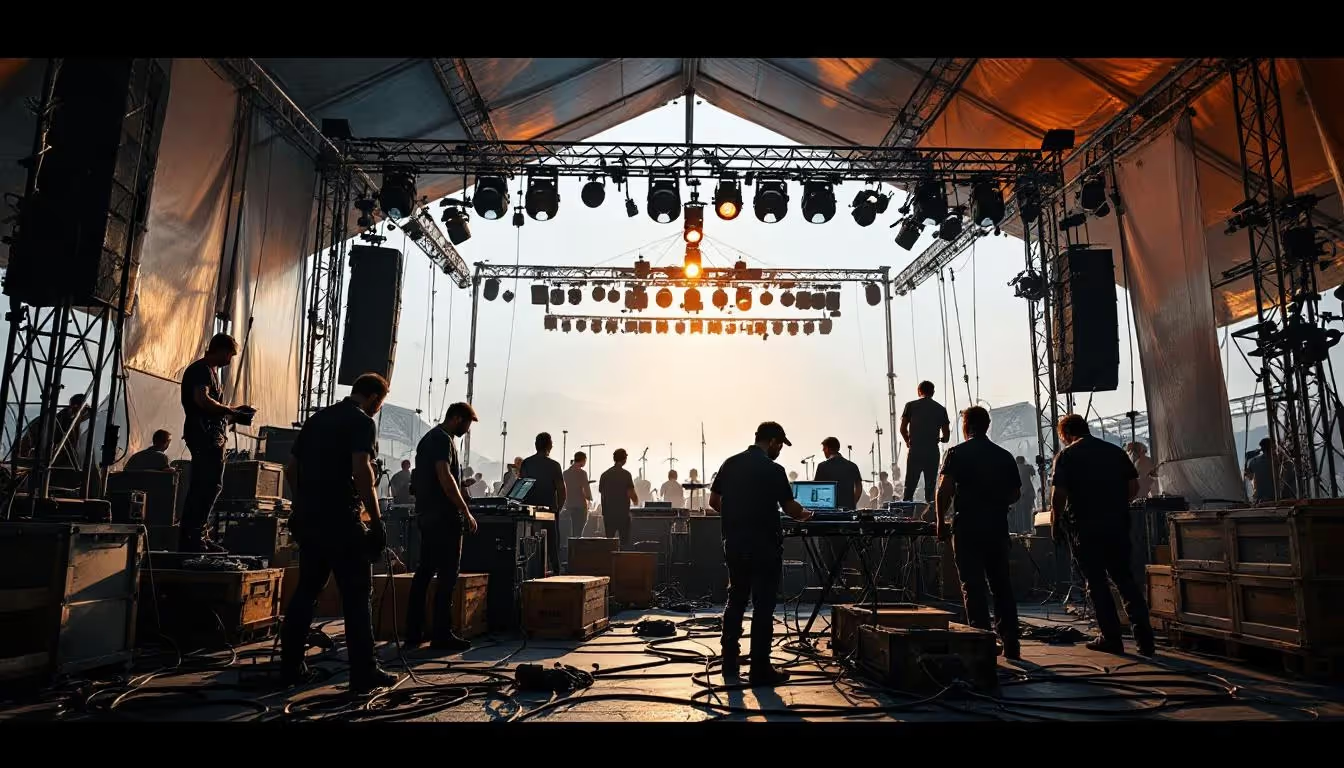
Mixing in-person and digital elements at large-scale events is like juggling lightsabers. The slightest error in timing or coordination can ruin everything, especially with complex technical infrastructure.Digital events require surgical precision.
XXL hybrid events present several technical and logistical challenges:
- Complex coordination between field teams and remote technicians
- Major technical risks (streaming interruptions, platform bugs)
- Imbalance of attention between in-person and virtual audiences
- Budget overload with dual physical/digital logistics
- Difficulty maintaining engagement on long hybrid formats
Without dedicated management, you risk technical bottlenecks: glitchy broadcasts, remote participants disconnecting, and overlapping interventions.
The worst part? An uneven experience that gives participants the impression of attending two different events.
The key role of stage management
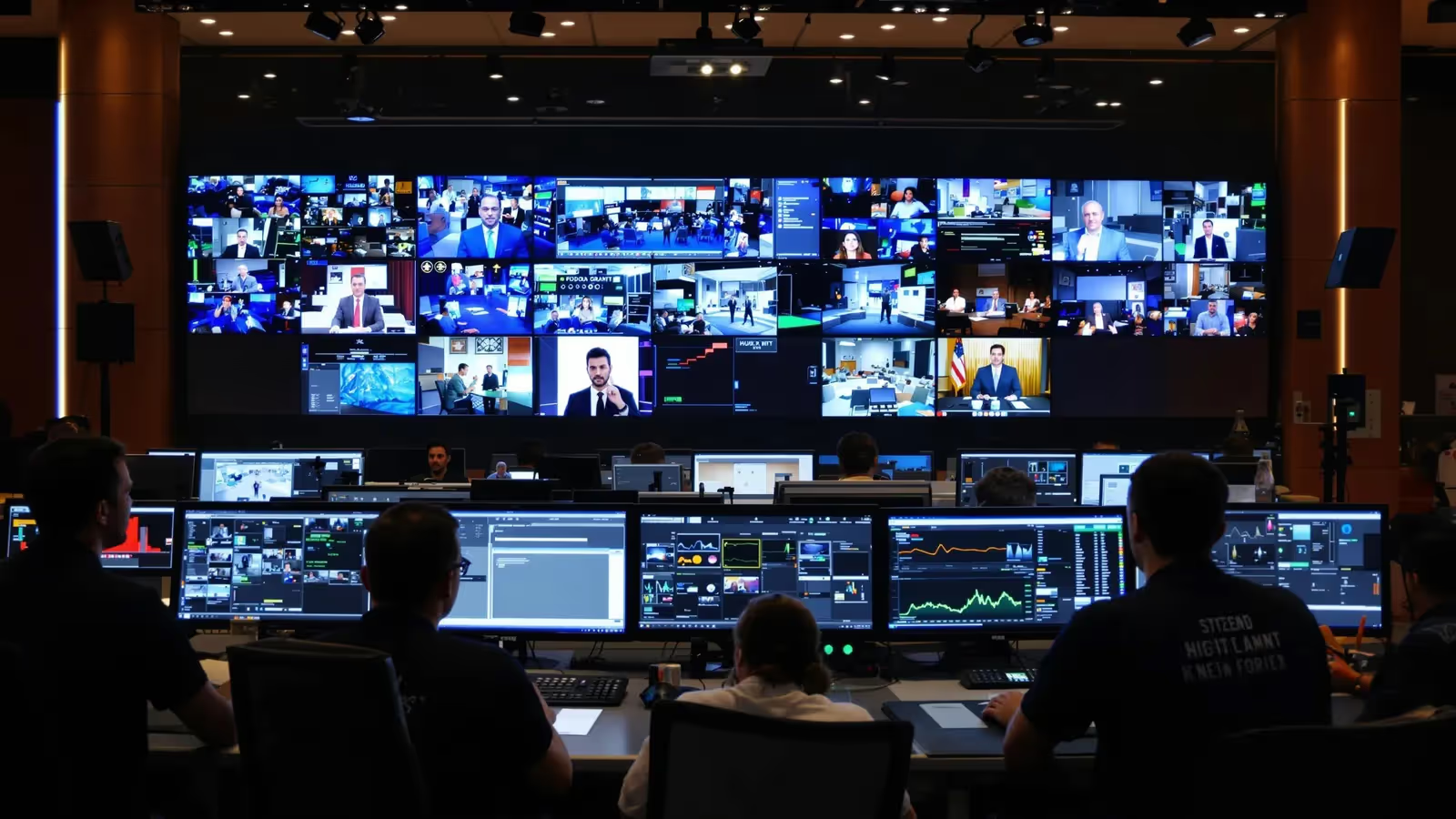
The control roomis the HQ that keeps your hybrid event running smoothly. It's a real command center where every decision impacts both the physical and digital aspects of the event. Without it, your technical and logistics teams risk getting in each other's way.
Multi-dimensional management
Keeping pace between a packed room and online participants requires great time management skills. Stage managers juggle speaker delays and questions coming in via chat in real time.
Tight deadlines? We manage them with flexible schedules that include buffer slots. The idea is to always have some leeway to absorb delays without disrupting the program.
Anticipating the unexpected
When streaming fails, teams switch to the backup in 30 seconds flat. Two streams are always ready, with an automatic switchover system that prevents total blackout.
Each resolved incident ends up in a shared knowledge base. Newcomers can thus learn from real-life cases before they even start.
Resource optimization
HD cameras are used for both live capture and replay recording. One investment, two uses.
Negotiating framework agreements with technical service providers can reduce costs by 15 to 20%. The trick is to pool requirements across several events to obtain volume discounts.
The budget remains flexible thanks to real-time monitoring of expenses. If an item costs more than expected, it is immediately offset by cutting back on less critical items. Modern audiovisual technology tools help to maintain control.
Measurable impact on results
Consistent user experience
The challenge is to adapt the content so that Jean-Pierre in the theater and Marie behind her screen have the same experience.
We shorten presentations for digital audiences, add interactive quizzes, and alternate formats every 20 minutes. Statistics show that this boosts attention by 40%.
Real-time tracking tools monitor survey participation rates, average time spent per session, and the number of questions asked. This allows the program to be adjusted on the fly if necessary.
After the event, we send out a short questionnaire via text message and email. Responses are fed directly into a dashboard, ready to be analyzed to improve the next edition.
ROI optimization
A well-oiled production team can save up to 30% on technical costs. How? By avoiding redundant equipment and optimizing service provider schedules.
Media visibility skyrockets when you master broadcasts. We have already seen replays of key speeches generate 150% more traffic on the client's website in the week following the event.
The content produced during the event is then used for months afterward: video clips for social media, interviews for the blog, engagement data to refine marketing personas.
Adaptability to new formats
Integrating new streaming technology? We first test it on a small pilot event with 20% of the audience as beta testers. If it works, we roll it out to everyone.
Technical teams undergo express training modules before each event. The latest: a two-hour workshop on the new features of hybrid platforms.
Competitive intelligence is gathered using tools that scrape the programs of major events in the sector. We identify best practices that can be adapted within 48 hours.
Legal risk coverage
The Terms of Use now include an informed consent clause for data use. Participants know exactly what is being done with their information, whether in person or digitally.
For streaming copyrights, we use a platform that automatically manages licenses for music and images that are broadcast. No more risk of forgetting a copyright.
Specific civil liability insurance covers both material damage on site and online data leaks. Confidentiality clauses are systematically checked with technical service providers.
Selection of technical partners
Key skills checklist
Choosing the right service providers for a hybrid event is like putting together a dream team. First, check that they have already worked on similar formats. Ask for client references with at least three hybrid events under their belt.
- Cross-channel expertise verified on similar references
- Equipment compatible with your current and future hybrid needs
- Ability to provide real-time technical backups
- Certified training courses on the latest software solutions
- Contractual flexibility for adjustments during the event
We always perform a technical compatibility test before signing. The service provider must prove that their equipment works with your existing tools without any bugs.
Coordination of external stakeholders
From the outset, it is clearly established who does what between you, the sound provider, the streaming specialist, and the logistics manager.
A task distribution chart is circulated among everyone to avoid duplication.
All service providers use the same reporting tool with common KPIs: average response time, incident resolution rate, field team satisfaction.
This allows for an objective comparison of performance.
When two suppliers are in dispute, we apply the 24-hour rule: an emergency meeting is held with all parties to find a solution before the end of the next working day. No conflicts are allowed to drag on.
Continuous quality control
Surprise audits are conducted during critical phases. In particular, technical installations are checked for compliance and safety procedures are verified. Any discrepancies are noted and corrected immediately.
Field reports are submitted via a dedicated app where each technician can report a problem in just two clicks. Tickets are processed in order of priority and tracked in real time on a board visible to everyone.
Contracts now include bonus/penalty clauses based on specific targets: a 5% bonus if customer satisfaction exceeds 90%, and a 10% penalty for unjustified delays in key deliveries.
Changes in the advertising industry
The role of stage manager is evolving faster than ever. Today, professionals are required to have both advanced technical skills and real agility with new digital tools. Those who ride this wave have a big advantage.
AI is starting to manage all real-time flow monitoring. It detects network anomalies or drops in video quality before we see them. However, humans remain essential for interpreting data and making strategic decisions.
Younger generations are demanding more immersive experiences. We are currently testing augmented reality integrations that allow remote participants to interact with the physical setting via their smartphones.
As the latest hybrid trends show, this completely changes the game when it comes to engagement.
Tomorrow's directors will need to master AI moderation software, predictive analytics tools, and mixed reality platforms.
Continuing education is becoming as important as field experience in order to stay competitive.
Solid overall management remains your best asset for successful hybrid events.
Team coordination, managing unexpected events, optimizing the budget: every aspect counts.
By structuring your management now, you can guarantee a smooth experience for everyone. The future of events depends on this technical and logistical expertise.