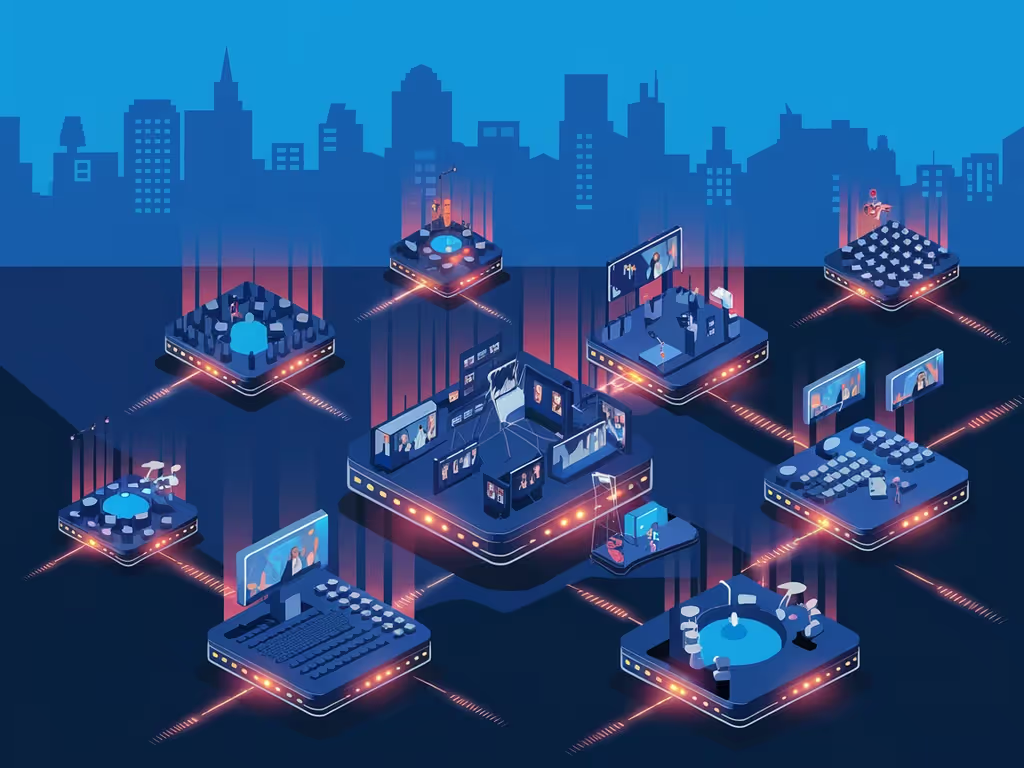
Multi-site events, which account for 34% of major productions according to the Futuresource Consulting 2024 report, require rigorous technical planning and redundant infrastructures to ensure their success. A well-designed strategy relies on robust technologies, fluid coordination and centralized supervision.
Network infrastructures: the backbone of multi-site events
Connectivity is the cornerstone of multi-site production. A solid, well thought-out network infrastructure guarantees stable, high-performance transmission between sites, even in the event of technical failure. Here are the key elements:
- Fiber optics: Using SMPTE 2110 double rings with automated A/B paths enables active redundancy. This means that if one path fails, the second immediately takes over.
- Backbone: The backbone is the main structure of the network. It is a very high-speed link that connects the various sites. A minimum data rate of 10 Gbps per site is recommended to support high-resolution video and audio streams without loss of quality.
- QoS (Quality of Service): This system prioritizes critical flows (such as live video or audio) by allocating sufficient bandwidth. This prevents lower-priority applications (such as downloads or browsing) from disrupting essential transmissions.
Network topologies for resilience
Network resilience is crucial for a multi-site event. Here are the three most common configurations:
- Star configuration: each site is directly connected to a central hub. This configuration is easy to manage, but vulnerable if the central hub fails.
- Ring assembly: All sites are connected in a loop, offering an alternative path in the event of failure. This significantly increases reliability.
- Hybrid mesh: This configuration combines several topologies to guarantee maximum redundancy, ideal for critical or complex productions.
Modern infrastructures often combine dedicated fiber and mobile networks (4G/5G) for optimum stability.
Transmission and backup solutions
To minimize interruptions, a layered transmission system is essential:
- Main: Dedicated optical fiber remains the preferred solution for its reliability and ability to transmit very high quality data.
- Backup 1: 4G/5G bonding, which aggregates several mobile connections from different operators, offers a fast, adaptable backup solution.
- Backup 2: Satellites equipped with HEVC (High-Efficiency Video Coding) compression enable transmission to be maintained even in isolated areas or in the event of a major terrestrial network failure.
Recent tests have shown that a switch between these systems can be made in less than 2 frames (around 0.08 seconds), guaranteeing a seamless experience for viewers.
Inter-site coordination and communication
Orchestrating technical teams spread over several sites requires robust communication tools and flawless organization. Here are the essentials:
- Digital Matrix: These high-capacity communication systems enable technical teams to communicate in real time without saturation, even in complex configurations.
- HF coverage: Radio frequency planning is crucial to avoid interference and guarantee coverage without blind spots.
- Dedicated workflows: Specific communication groups (audio, video, logistics) facilitate coordination and reduce the risk of errors.
Inter-site communication is the key to managing unforeseen events and ensuring smooth execution.
Centralized supervision and real-time monitoring
Centralized supervision, often organized via an MCR (Master Control Room), is essential to guarantee the quality and reliability of the event. Its main functions are
- Stream monitoring: Real-time monitoring of audio and video signals to quickly detect and resolve problems.
- Switching matrix management: Enables uninterrupted switching from one source to another in the event of a power failure.
- Supervision of inter-site links: Constant checking of network connection stability.
Modern supervision tools include :
- Real-time dashboards: display key metrics such as latency, bandwidth used and flow errors.
- Predictive alerting: Artificial intelligence-based systems can anticipate failures by analyzing anomalies, reducing technical incidents by 47% according to an IEEE 2023 study.
The MCR acts as a veritable "control tower", ensuring overall coordination and quality.
Towards controlled audiovisual coverage
The success of a multi-site event rests on three pillars:
- Advanced technology: to guarantee transmission and redundancy.
- Human coordination: seamless communication between on-site and remote teams.
- Centralized supervision: anticipate and solve technical problems in real time.
With careful planning, appropriate infrastructures and modern tools, multi-site events offer a professional, immersive and reliable experience, meeting the ever-increasing expectations of audiences.
Case study : Multi-site production for an automotive product launch
To illustrate best practice, let's look at the case of a carmaker who organized a multi-site event for the worldwide launch of its new electric model.
The event took place simultaneously in three key cities: Paris, New York and Tokyo, with thousands of participants on site and an online audience exceeding 500,000.
Technical challenge
The aim was to broadcast synchronized, high-resolution content between the three sites, while guaranteeing live interaction between teams and participants.
The main challenge was to coordinate video and audio streams in real time across different time zones, while avoiding interruptions.
Solutions provided
- Network infrastructures :
- A 10 Gbps fiber optic backbone connected the three sites.
- A QoS system prioritized the transmission of 4K video streams for live presentations.
- Backups via 5G bonding ensured complete redundancy.
- Centralized supervision:
A London-based MCR supervised the entire transmission, monitoring flows and coordinating automatic switchovers in the event of failure. - Interactive engagement :
- A dedicated application enabled online participants to ask questions live, relayed simultaneously across the three sites.
- A social networking campaign using the hashtag #FutureDrive2024 generated over 50,000 interactions by the end of the event.
Results
The event was a major success:
- 99.8% network availability thanks to redundant architecture.
- Switching time between backups reduced to 1.5 frames, imperceptible to the audience.
- A 35% increase in leads generated compared with their previous launches.
This case study shows how meticulous planning, advanced technologies and seamless coordination can transform a multi-site event into a truly global success.